The Narcissistic Family Mirage: Why Nothing Is What It Seems
In philosophy, ontology is the study of being — what exists, what is real, and how we test reality. In a healthy family, members develop their own ontology: a grounded sense of self, independent beliefs, and the ability to distinguish what is real from what is projected onto them.
In the narcissistic family, there is no shared reality. There is only the narcissist’s reality — and everyone else is expected to merge with it. This is the Ontological Mirage: the illusion that your family operates on truth, love, and mutual respect, when in fact it operates on control, image management, and emotional fusion.
The Illusion of Harmony
On the surface, the narcissistic family may appear enviable. There is a perception of harmony, success, and togetherness. Outsiders see a caring, loving family. But behind closed doors, there is coldness, subtle put-downs, and a pervasive sense that something is off.

This is what Kierkegaard might call the uncanny — the familiar rendered strange. You grew up in this system. You knew the rules. Yet something always felt wrong, and you could never name it. The narcissist’s ability to construct a convincing facade is what makes the mirage so disorienting. They are weak but give the allure of grandeur. Flying monkeys and drama create the illusion of a tight-knit family — hiding deep insecurities and dysfunction beneath.
Cold Empathy and the Conscience Gap
One of the most confusing aspects of the narcissistic family is the presence of what appears to be empathy — but isn’t.
Cold Empathy is the narcissist’s ability to read emotions with surgical precision without actually feeling them. They understand that you are hurt. But they use that understanding not to repair the relationship, but to manipulate the outcome. They know exactly which buttons to push because they installed them.
This relates to what Dr. George Simon calls the Conscience Gap. If you are reading this, you are likely a “neurotic” in the clinical sense — someone with a strong capacity for self-reflection, guilt, and empathy. You assume the narcissist shares these qualities. They do not. They operate with Character Disturbance — externalizing blame rather than internalizing it. You project your conscience onto them, waiting for an apology that will never come because they do not experience the guilt that would produce one.
Snapshotting: Why They Don’t See the Real You
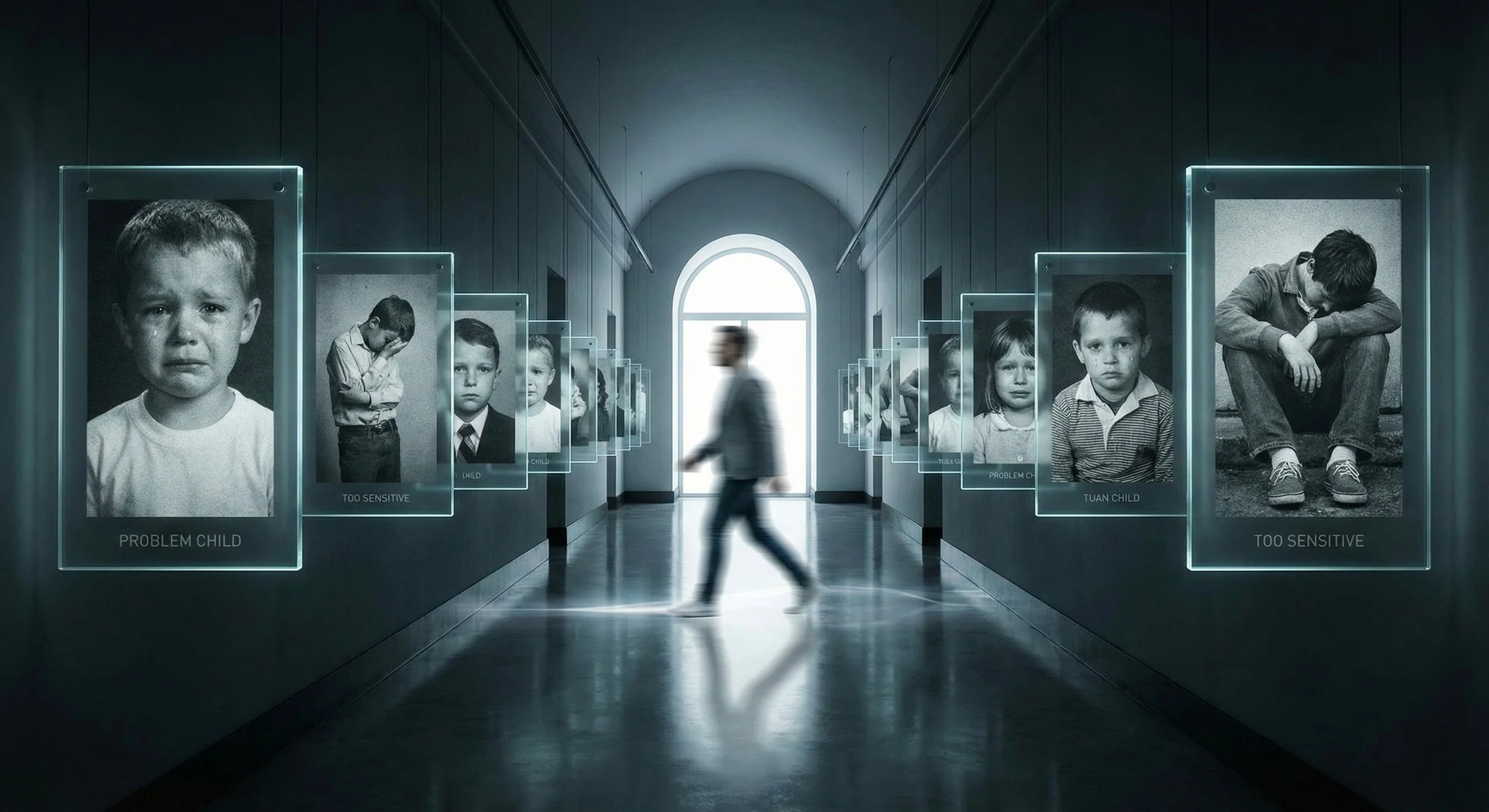
Sam Vaknin describes a mechanism called Snapshotting. The narcissist takes a mental “snapshot” of you — typically at a moment of vulnerability or perceived weakness — and internalizes it as a fixed internal object. They do not relate to the living, evolving you. They relate to this static Introject.
This is why you can achieve tremendous personal growth, build a successful career, or become a completely different person — and they still treat you like the rebellious teenager or the incompetent child. They are not interacting with your Authentic Self; they are managing their relationship with a Role Self they assigned to you long ago.
The Family’s Emotional Ontology
Murray Bowen’s Family Systems Theory helps us understand why this mirage is so persistent. The narcissistic family functions as a single emotional unit. Members are not differentiated individuals — they are emotionally fused. The narcissist attempts to merge everyone’s reality into their own, creating what Bowen calls an undifferentiated ego mass.
To break free, you must map the emotional ontology of your family — the being, the facts, the patterns. You have to name the system as it actually is, not as it presents itself. This means recognizing the roles (scapegoat, golden child, lost child), the alliances, the triangulation, and the emotional fusion that holds the system together.
From Role Self to Solid Self

Bowen distinguishes between the Pseudo Self and the Solid Self. The Pseudo Self is the adaptive identity you developed to survive the family system — the people-pleaser, the peacekeeper, the high achiever who earns love through performance. The Solid Self is who you actually are beneath the roles: your values, your convictions, your non-negotiables.
The narcissistic family demands that you remain a Pseudo Self because a differentiated individual threatens the system’s homeostasis. The truth-teller — the scapegoat — poses a mortal threat to the shared fantasy. When you begin developing a Solid Self, the system fights back with guilt, smear campaigns, and hoovering.
The path forward is Differentiation: grounding yourself in your own reality, developing your own ontology, and refusing to merge with the family’s distorted narrative. This does not mean cutting off all emotion — it means being able to think in the presence of intense emotional pressure from the family system.
For deeper reading on Bowen Family Systems Theory, emotional differentiation, and the narcissist’s internal world, see my Reading List.
Ready to Go Deeper?
Join the Sovereign Scapegoats — a guided recovery community where scapegoats break free from narcissistic family systems together. You’ll get access to The Ascent (a structured recovery program), weekly insights, and a space where people actually understand what you’ve been through.
Not sure where to start? Take the free Four-Quadrant Family Origins Assessment to map how your family system shaped your patterns. Or book a free consult to explore 1:1 therapy (Ontario) or coaching (international).