Why Narcissistic Families Target the Scapegoat
If you are the scapegoat in a narcissistic family, you have asked yourself this question a thousand times: Why me?
The answer is not about your flaws. It is about the family’s need for a container — someone to absorb the dysfunction so the rest of the system can maintain its illusion of normalcy. You were not chosen because you were broken. You were chosen because you were strong enough to carry it.

The Identified Patient
In family therapy, we use the term Identified Patient (IP) to describe the family member who is brought forward as “the problem.” The narcissistic parent, unable to own their own psychological material, projects it outward through Projective Identification. The family’s collective anxiety, shame, and unresolved trauma are exported into one child.
You become the lightning rod. When the family is stressed, you absorb the charge. When there is conflict, you are blamed. When there is dysfunction, you are identified as its source. This is not accidental — it is a systemic mechanism designed to protect the narcissist’s fragile ego and maintain the family’s homeostasis.
The Dual Mothership Trap
Many scapegoats operate under what I call the Dual Mothership Model. On one hand, the narcissistic parent presents as the nurturing, sacrificing mother or father — the public-facing persona that earns them sympathy and social capital. On the other hand, behind closed doors, they are controlling, dismissive, and emotionally abusive.
The trap is that both versions feel real. The intermittent reinforcement — the occasional warmth, the random act of generosity — keeps you bonded. You know intellectually that the dynamic is toxic, but the “good” parent keeps showing up just often enough to trigger the healing fantasy: Maybe this time it will be different. Maybe if I just explain myself clearly enough, they’ll finally understand.
They won’t. The Dual Mothership is not two people — it is one person with a strategic repertoire. The warmth is the hook; the cruelty is the trap.
Why the Scapegoat Is Targeted
The scapegoat is typically the most perceptive child in the family — the one who senses that something is off and, consciously or not, names it. In a system built on denial and image management, the truth-teller is the greatest threat.
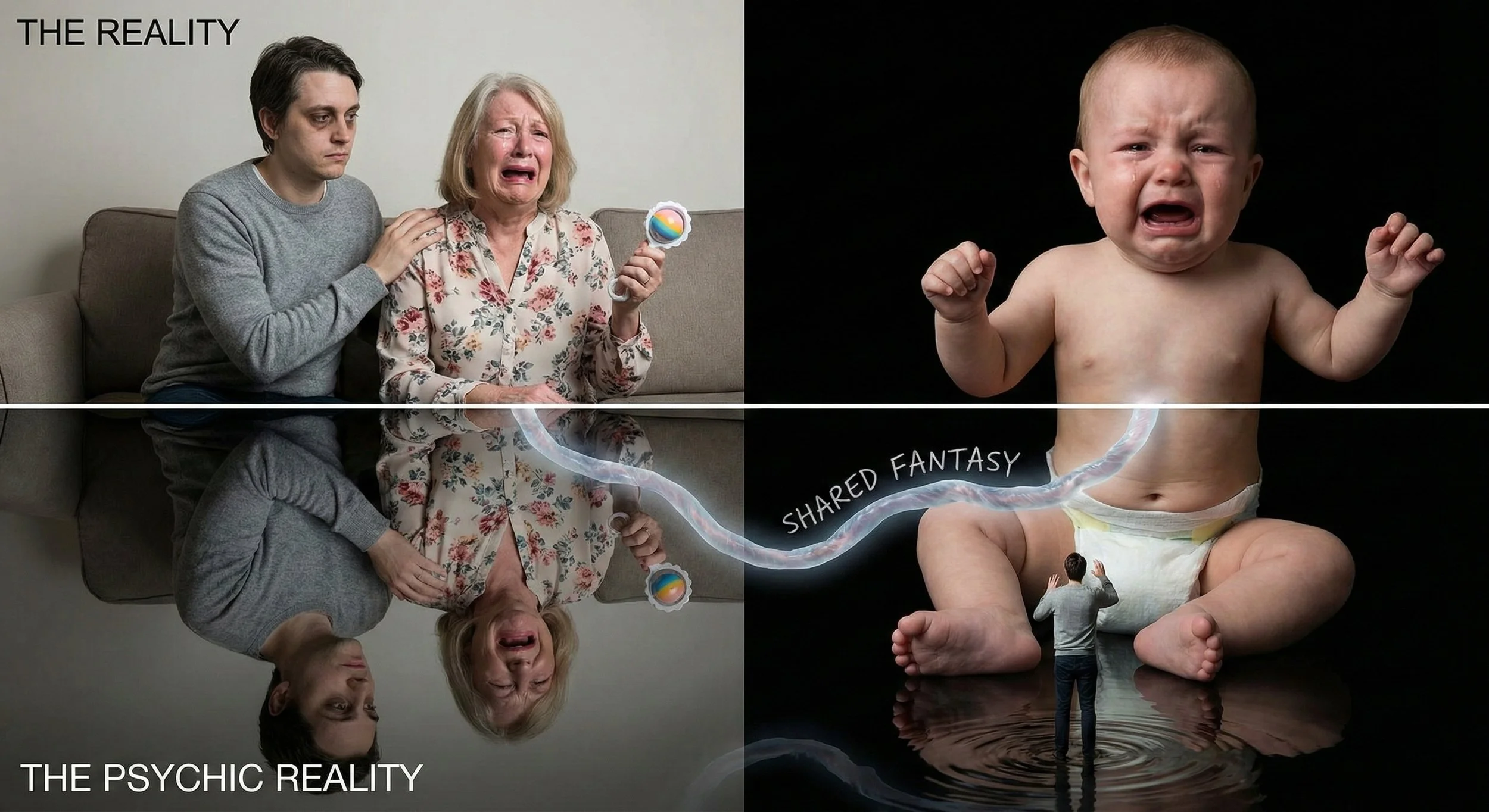
Murray Bowen’s concept of triangulation explains the mechanism. When tension rises between two people (usually the parents), a third person is pulled in to diffuse the anxiety. The scapegoat is triangulated into every conflict, used as a pressure valve. Over time, this becomes the child’s permanent role — not because of who they are, but because of what the system needs them to be.
The narcissistic parent also engages in splitting — dividing children into “all good” (the Golden Child) and “all bad” (the Scapegoat). This black-and-white thinking prevents the children from forming genuine alliances and keeps the narcissist firmly in control.
The Nervous System Trap
The scapegoat trap is not just psychological — it is physiological. Years of hypervigilance rewire the nervous system for constant threat detection. Your amygdala is on perpetual high alert. Your body learned that love and danger come from the same source, creating what Patrick Carnes calls a betrayal bond.
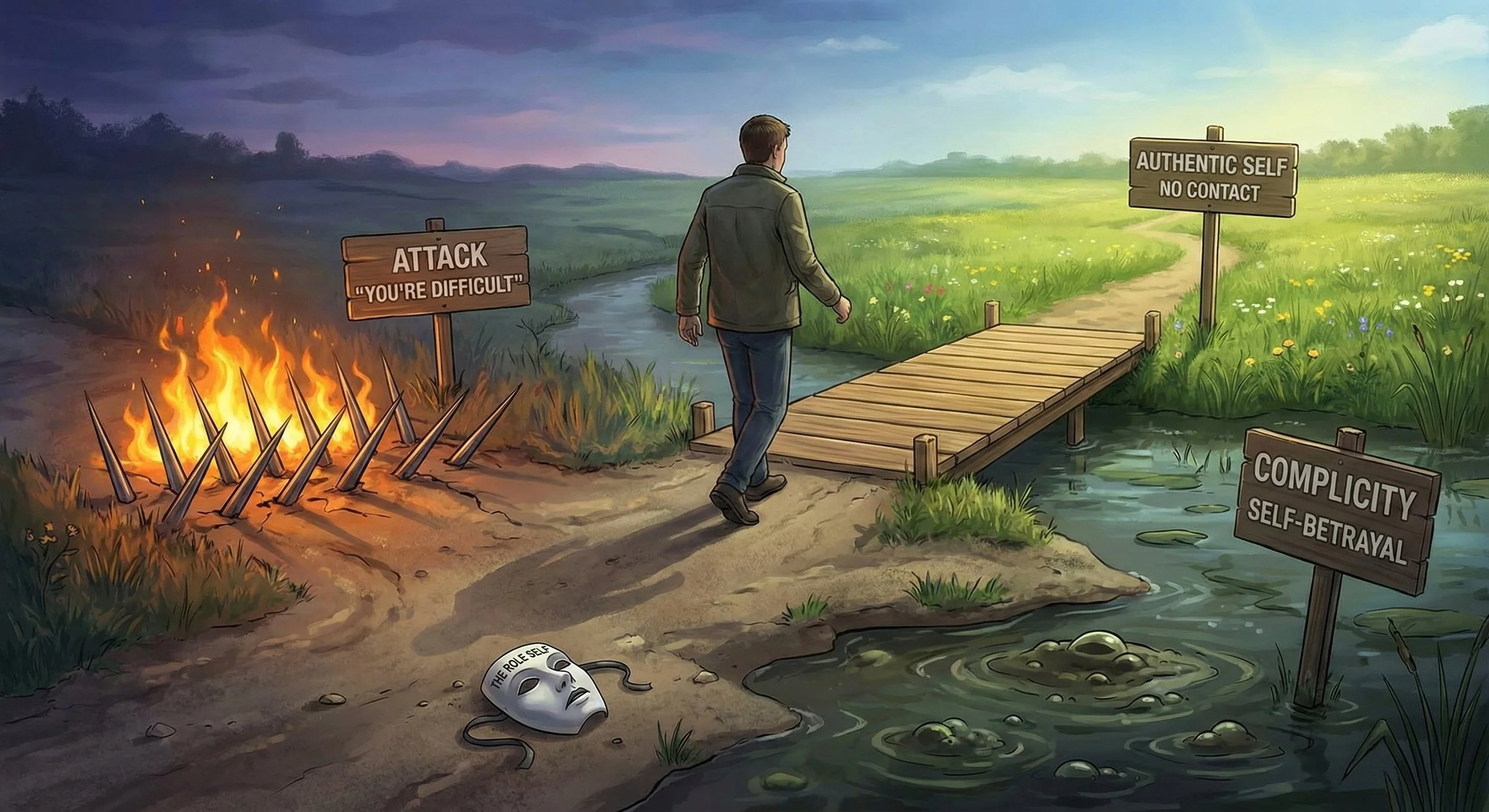
This is why Repetition Compulsion is so common among scapegoats. You unconsciously seek out familiar dynamics — emotionally unavailable partners, toxic work environments, friendships that feel “like home” — because your nervous system confuses familiarity with safety. Breaking the trap requires not just cognitive insight but somatic regulation: teaching your body that safety does not require vigilance.
Breaking Free with IFS
Internal Family Systems (IFS) therapy, developed by Richard Schwartz, offers one of the most effective frameworks for retiring the scapegoat role. IFS recognizes that we all carry internal “parts” — protectors, exiles, and managers — that developed in response to our environment.
The scapegoat often has a powerful Protector part that learned to absorb blame and manage the family’s emotions. There is usually an Exile — a wounded inner child carrying the original pain of rejection and betrayal. And there are Managers — parts that maintain hypervigilance, people-pleasing, or emotional numbness to prevent the Exile from surfacing.
The goal of IFS is not to eliminate these parts but to unburden them — to access the Self (capital S), which is characterized by curiosity, compassion, and calm. From Self, you can dialogue with the Protector and thank it for keeping you alive. You can gently approach the Exile and let it know the danger has passed. You can retire the scapegoat role not by fighting it, but by understanding why it existed in the first place.
For deeper reading on IFS therapy, betrayal bonds, and family systems theory, see my Reading List.
Map Your Family Dynamics and Start Healing
Take the free Four-Quadrant Family Origins Assessment to understand how your family system shaped your thoughts, emotions, body, and relationships. You’ll also get the Healing & Growth Toolkit — practical worksheets and strategies from 14+ years of clinical work.
Ready for deeper support? Join the Sovereign Scapegoats community for guided recovery alongside others who understand, or book a free 15-minute consult to explore 1:1 therapy (Ontario) or coaching (international).