The Milgram Experiment and the Narcissistic Family: Why Siblings Enable the Abuse
I've been working through The Sociopath Next Door by Martha Stout, and one chapter that keeps following me around the office is her use of the Stanley Milgram experiment to ask a hard question: how does an ordinary person come to harm another ordinary person when an authority figure says to continue?
Stout was writing in the early 2000s, and she was asking that question about politics and public life. I want to ask it inside the family system — because once you see the mapping, it becomes very hard to keep blaming yourself for what your siblings did and continue to do.
The Experiment, Briefly
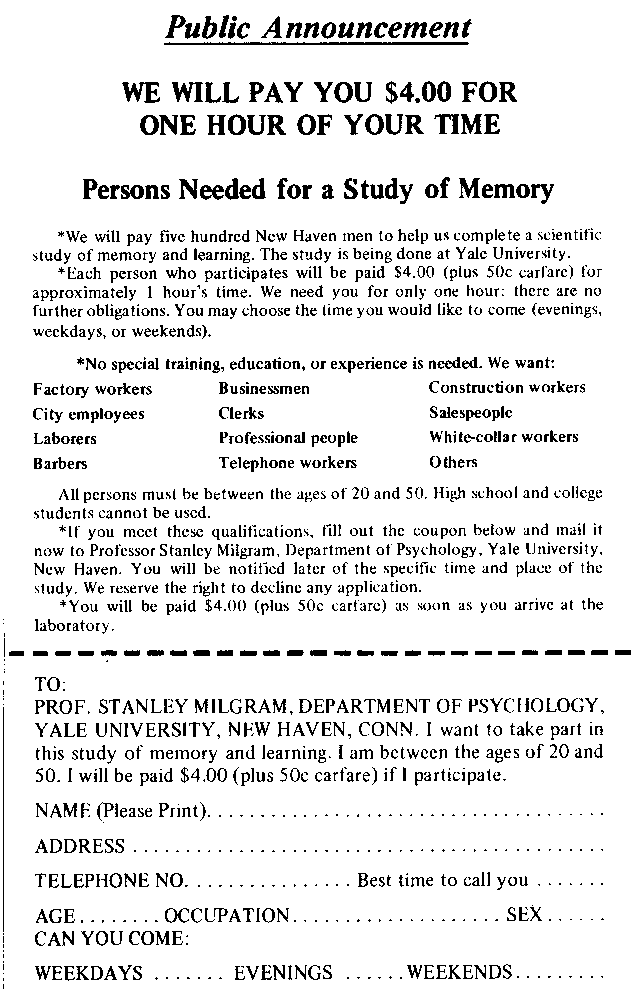
Milgram ran the original study at Yale in 1961 — in the basement of Linsly-Chittenden Hall, an old stone building with the kind of ivy-and-prestige authority that was, in Milgram's own words, part of the apparatus. Across all his variations, roughly 780 ordinary men took part — postmen, salesmen, teachers, engineers. The recruitment ad offered four dollars for one hour of time.
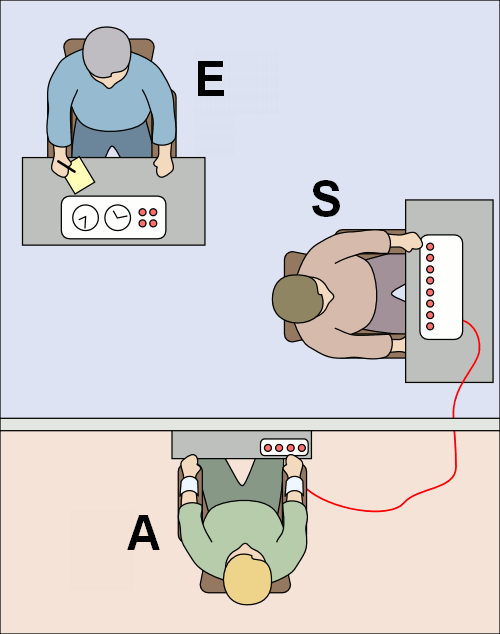
A rigged draw assigned each volunteer to the role of teacher. They sat at a shock generator with thirty switches, fifteen volts apart, running from a mild 15-volt jolt up to 450 volts, labelled XXX. On the other side of the wall was the learner — an actor, strapped to a chair. Every wrong answer earned a higher shock. At 300 volts the learner pounded the wall. After 315, silence.
When the teacher hesitated, the experimenter — a man in a grey lab coat — said one of four scripted prods, in order:
- "Please continue."
- "The experiment requires that you continue."
- "It is absolutely essential that you continue."
- "You have no other choice — you must go on."
That was the apparatus.
What 65% Actually Means
Before the results came out, Milgram asked a group of Yale seniors to predict how many participants would go all the way to 450 volts. Their estimate was 1.2% — a vanishingly small minority of psychopaths, they assumed.
The actual number was 65%. In the baseline condition, 26 of 40 ordinary men delivered the maximum 450-volt shock. The forecast was off by an order of magnitude.
A few notes that don't usually get repeated in the social-media version of this study:
- Obedience was not indifference. Fourteen of the forty participants showed nervous laughter or smiling during the shocks. Three had full, seizure-like reactions. Participants protested, negotiated, delayed. The conscience was not absent. It was overruled.
- The finding survived ethics review. In Burger's 2009 partial replication, seven in ten participants had to be stopped at 150 volts as they tried to keep going.
- Female participants showed the same compliance rate in later variations, often with more visible distress.
Stout's gloss is the one that lodged in me: in The Sociopath Next Door, she estimates that roughly 4% of the population has no functional conscience, and that of the remaining majority, only about one third will actually stand up to a conscientious objection — especially when no one else around them is speaking up.
The Lab Inside the Family
Here is where the experiment becomes a clinical tool.
When an authority figure objectifies another person — turns them, in Martin Buber's language and Stout's, into an it — the conscience of the people in the room can be redirected around them. The target is no longer fully a person. The harm becomes a duty.
That is the architecture of the narcissistic family.
The parent — usually a covert, expert narcissist — sits in the experimenter's chair. They define reality and they give permission to continue. The sibling stands at the teacher's console. They carry out the correction while feeling loyal, helpful, responsible. The scapegoated child is behind the wall — isolated, spoken about, acted upon.
The translation of the prods is almost too clean:
In the lab In the family "The experiment requires that you continue." "Don't upset your mother." "It is absolutely essential that you continue." "The family needs peace." Fifteen-volt increments Small repeated betrayals of reality Leaving the experiment Differentiation — refusing the role
This is what Murray Bowen named the family projection process: parental anxiety gets focused onto a particular child, who becomes the container for the family's disowned shame, conflict, and instability. Bowen called this child the identified patient — the one who appears to be the problem, and who also reveals what the family is unwilling to look at.
The siblings don't have to be cruel for this to work. They only have to be obedient.
![IMAGE 2: A side-by-side composition — left side, Milgram's three-room lab diagram in muted blues; right side, the same diagram rendered as a family living room with the parent in the experimenter's place, a sibling at the console, and an empty chair behind a wall labelled "the scapegoat." Cinematic painterly realism, soft amber light.]
Two Kinds of Foot Soldier
Once you sit with the numbers, the question of "would a sibling really do this?" answers itself in two ways.
The minority. A small share of enablers belong to Stout's roughly 4% — antisocial, low-empathy, low-remorse. Lifetime prevalence of antisocial personality disorder in the clinical literature runs in the 2–5% range. With this sibling, the parent's whispered continue is barely needed. They are happy to go to 450.
The majority. Most enabling siblings are not clinically antisocial. They feel something. They know, at some level, that the experiment is wrong. But role preservation, fear, financial dependency, fusion with the parent, or identification with authority is stronger in the moment than the conscience. They obey because the cost of leaving the chair is too high.
Milgram's deeper finding is that you do not need a clinical disorder to participate in significant harm. You only need an authority figure who has organized your conscience around their definition of reality.
Flying Monkeys and the Smear
The same mechanism extends past the immediate family. The covert narcissist parent will often express concern about you to the extended family or community — "I'm so worried about him, I've really tried to help him, but he's been saying these kind of things." The framing is care; the function is discrediting.
The flying monkey doesn't typically deliver the maximum shock. They deliver a partial one. They cool toward you at a holiday. They repeat something they were told. They stop returning your call. They have been moved a few volts up the dial, on the strength of an authority figure they trust and a story they were given. They feel loyal, helpful, responsible — exactly the way the teacher at the console did.
The Way Out
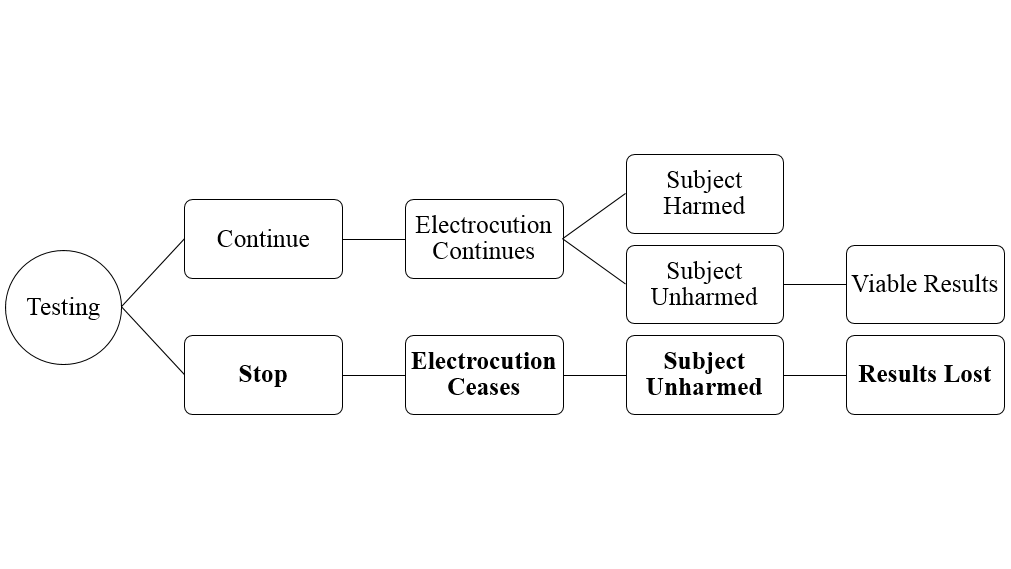
Milgram's design closes off most exits on purpose. The teacher can argue with the experimenter, hesitate, sweat, laugh — and still keep pulling the lever. The one thing that ends the harm is leaving the chair.
In the family system, that's differentiation. Not winning the argument. Not getting the parent to admit the pattern. Not convincing the sibling that you were never the problem. Those are all moves inside the experiment, and the experiment is rigged.
The way out is to unstrap yourself, walk past the prods, and stop responding to the bait. Even — and this is the hard part — even when there is guilt on the way out. The guilt is the apparatus working as designed. It is not a moral signal that you are wrong. It is a measure of how thoroughly the room had been organized around you staying.
The Deeper Claim
Milgram does not prove that people are monsters. It proves that conscience can be organized — around authority, role, and distance.
And what a laboratory can organize, a family can organize.
The good news, and the reason I keep returning to this study, is that the reverse is also true. What was organized can be disorganized, named, and walked out of — by the one person in the room who was never given the lab coat or the lever.
If you've ever wondered why siblings who seemed decent in any other context were the ones who carried the message, repeated the smear, stood by during the cruelty: this is the structure. They were not in the room with the truth. They were in the room with an authority figure who told them to continue.
You were behind the wall.
You don't have to win the experiment. You have to leave the chair.
Start the Work
Download The Scapegoat & Narcissistic Abuse Recovery Healing Toolkit & Family Assessment — a free 80-item assessment and clinical workbook drawing on Bowen Family Systems, IFS, and Jungian frameworks.
Join The Ascent — Sovereign Scapegoats Course & Community — courses, community, and weekly live calls.
Try the Sovereign Scapegoat GPT — an AI coaching assistant trained on Bowen differentiation, Jungian shadow work, and polyvagal theory.
Book a 1:1 Consultation — work with me directly.
Blake Anderson, MSW, RSW — Registered Social Worker & Therapist, Toronto, Ontario
This content is for educational purposes only and is not a substitute for personalized therapy or clinical advice.