
Scapegoat recovery · Blake Anderson, RSW
The scapegoat role was assigned, not chosen.
In a narcissistic or emotionally immature family, someone has to hold what the system cannot look at. The scapegoat absorbs the projected shame and blame. The golden child is idealized. Everyone else keeps the peace by agreeing. If you were the one cast as the problem, this page is about what that costs and what recovery actually involves.
Ontario psychotherapy · Video coaching beyond Ontario · You don’t need a diagnosis for anyone to begin

The pattern
The family operates as a royal court.
Every court needs a throne, a favourite, and someone to blame. The narcissistic family assigns those roles early and defends them hard. The scapegoat is often the most perceptive child: the one who notices what is wrong and says so. Naming the truth gets treated as the offence. Over time the family settles on one story about you, and the story serves the system. As long as you are the problem, nobody else has to change.
The projections usually carry a hook, a half-truth that makes them stick. You did get angry. You did pull away. The part they leave out is what you were responding to. Triangulation holds the arrangement in place: a parent and a sibling, or one parent and the other, talking about you rather than with you. That is why the role survives your leaving. It was never only about you. It was the family’s way of managing its own anxiety.
Holding the role is also, strangely, a gift and a curse. The scapegoat is frequently the family’s truth-teller, the one with the clearest view of the system. The curse is that nobody in the court wanted that view. The gift is that it is still yours.
What it costs
What carrying the role costs.
- Chronic guilt, and the habit of overexplaining yourself to people who decided long ago.
- “Was I the problem?” on repeat, years after you left the house.
- A body that fires first: tension before a phone call, a crash after a visit, sleep that will not settle.
- Grief for the family you needed, and for the one you keep hoping will finally show up. Many people call that hope the healing fantasy, and letting it go is its own loss.
- Rumination that feels like analysis but never ends in a decision.
- A sense of self organised around the role, so that stepping out of it feels like disappearing.
None of this means you are broken. It means you adapted to a system that needed you to carry its shame, and the adaptation outlived the household. The nervous system learned the family before you had words for it, which is why understanding alone rarely quiets it.

What the frameworks show
Why the perceptive child gets targeted.
Bowen family systems calls this the identified patient: the member whose symptoms express the anxiety of the whole system. Triangles keep that anxiety moving. Differentiation is the slow work of staying connected without being absorbed, of knowing where you begin and where the family system ends.
Object-relations thinking describes projective identification, where a family pushes its disowned feelings into one person until they begin to look like that person’s. Jungian psychology adds the shadow: what the family cannot own in itself, it finds in you. Internal Family Systems gives the inside view. Protectors learned to appease, explain or disappear; exiled parts still carry the shame they were handed. Recovery is not overriding those parts. It is unburdening them.
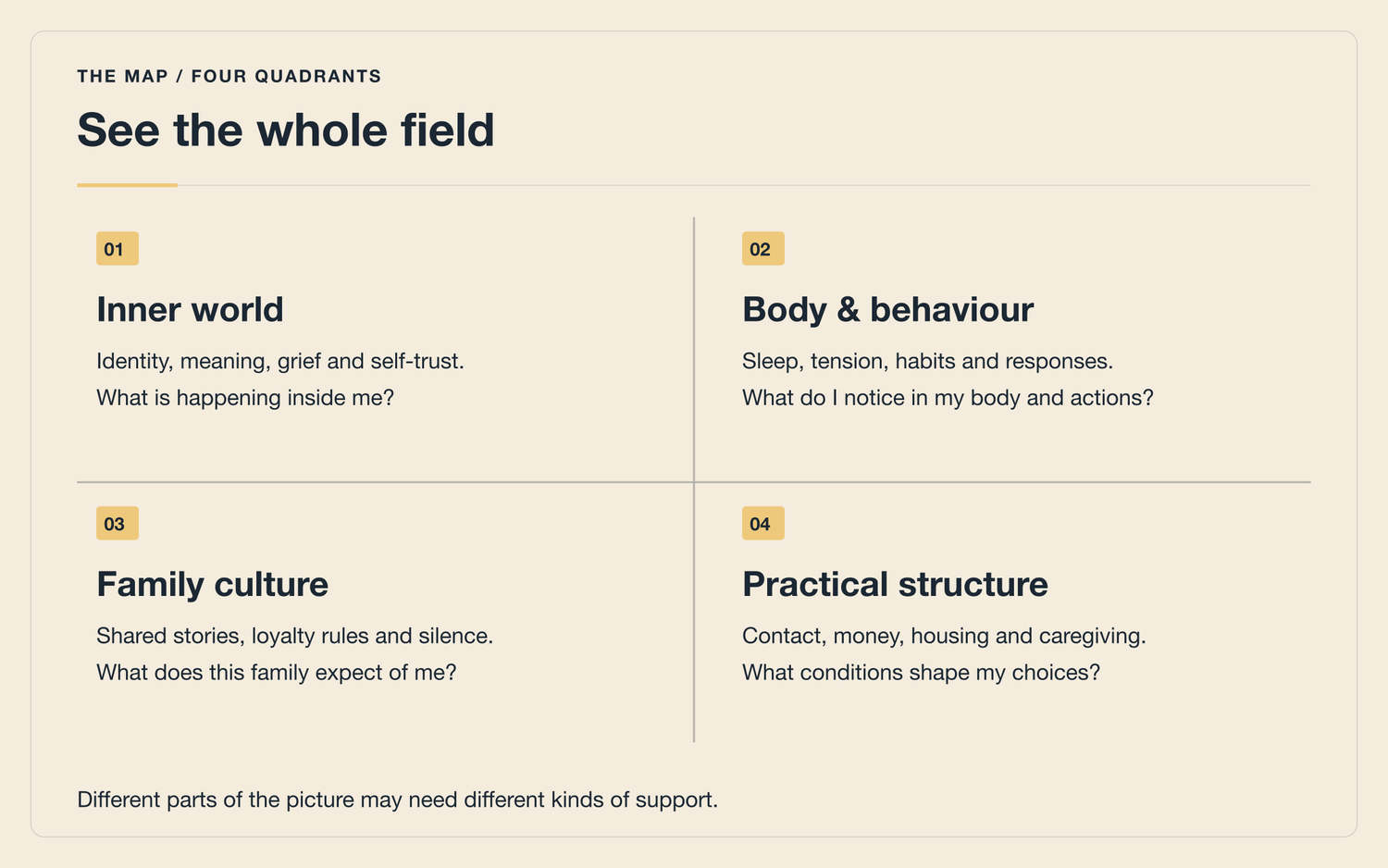
The Integral four quadrants keep the whole field in view: your inner world, your body and behaviour, the family culture, and the practical structure around contact, money and caregiving. Different parts of the picture need different kinds of support, which is why the same advice does not fit everyone.
Jay Reid’s Growing Up as the Scapegoat to Narcissistic Parents and Dr. Ramani Durvasula’s It’s Not You describe the same mechanics from different angles. The research-informed view is consistent: recovery needs reality testing, clear limits, and exposure to healthier relational templates.
How I help
Recovery is practice, not only insight.
Insight is where most people start and where many get stuck. Knowing the family is a royal court does not stop the guilt the next time the phone rings. The work, in one-to-one sessions and in The Ascent, is supported practice:
- Reality-trust. Testing “I’m the problem” against the evidence, so your own perception can hold under pressure. CBT does some of this; a steady second witness does the rest.
- Calm differentiation. Words for a clear no, and the practice of staying yourself in contact with people who want the old role back. Scripts help; so does rehearsing the moment the guilt arrives.
- Unburdening. IFS work with the protectors that learned to appease and the parts that still carry the shame, so the body stops bracing for a court that is no longer in session.
- Contact you choose. No-contact, low-contact and continued contact are context-dependent choices, not a moral hierarchy. We plan for whatever you decide, and for the pull that follows.
- A life beyond the role. The interests you dropped, relationships with reciprocity, your own personal manifesto, and a future that is yours rather than a reaction to theirs. That is the second mountain.
Ontario
Individual psychotherapy
Confidential, session-based work with a Registered Social Worker, in person in Toronto, by video or by phone. $175 USD per session; in Ontario, reach out about pricing in Canadian dollars.
Beyond Ontario
Video coaching
Education, strategy and future focus for the family you actually have. Not clinical psychotherapy. Single sessions or a six-session package.
Paced practice with others
The Ascent course + community
Twenty lessons, a private community and two live calls a week, for putting the work into practice between the hard moments.
Common questions
Before you reach out.
Do you diagnose my parents or siblings?
No. I don’t diagnose family members, and a label on them is not the goal. We look at the pattern that affects you, scapegoating, triangulation and projection, so that you can trust your own perception.
Will you tell me to cut off my family?
No. Contact decisions depend on your circumstances, and I will not prescribe a cutoff from a website or a first session. The work is to see the pattern clearly enough that whatever you decide is yours.
Is this therapy or coaching?
If you are physically in Ontario, one-to-one work is psychotherapy with a Registered Social Worker. Outside Ontario it is coaching and education, not clinical psychotherapy. The free 15-minute phone consult confirms which applies before you book.
I’m not ready to talk to anyone yet. Where do I start?
Start with the free videos on YouTube or the free toolkit, which includes the Ascent workbook and an optional 80-item self-assessment. Both are educational; the toolkit asks only for an email address.
One next step
You don’t need to be certain to begin.
You don’t need proof that your family is narcissistic, and you don’t need a plan for contact. A recent interaction or a recurring feeling is enough for a first conversation.